Disposable Paper Cup vs. Plastic Cup: A Cost-Per-Use Comparison for Cafés
Disposable Paper Cup vs. Plastic Cup: A Cost-Per-Use Comparison for Cafés
A café does not buy cups; it buys servings. The number that decides whether a cup programme is affordable is cost per use — what it actually costs to place one drink in front of a customer — and that number is built from five cost lines, not one. Unit price is only the first. The other four are accessories, storage and handling, compliance and labelling, and waste handling.
This comparison sets a disposable paper cup against a plastic cup on exactly that basis, for cafés running daily hot and cold beverage service. It covers the disposable beverage paper cup and the disposable cold drink paper cup, compares single-layer and double-layer construction across hot and cold drinks, and shows where the Kraft Paper Soup Bucket ZT gives better value for soup items. Product detail comes from KingHonor's published specifications; market and regulatory figures are attributed to their sources. One deliberate omission: this article publishes no per-unit price. Cup prices move with supplier, order volume, print coverage, freight and destination duty, so the guide hands you the calculation model and the verified product facts instead of invented metrics.
1. Why a unit-price comparison misleads café operators
Most cup decisions are made on a quotation that lists price per thousand. Dividing that figure by 1,000 assumes every purchased cup becomes a served drink. A café does not work that way, and the gap between purchased cups and served drinks is where the money goes.
Three everyday service patterns break the simple division:
- Sleeves and double-cupping. A single-layer hot cup is commonly handled with a sleeve or served as a double cup so the customer can hold it. Every one of those accessories is a second purchase attached to the same drink.
- Remakes. A cup that softens, leaks or fails at the seam does not just waste a cup — it consumes the drink inside it, the barista's time and the customer's patience. Leak performance belongs in the cost model, not in the quality notes.
- Format mismatch. Soup ladled into a beverage cup is a served item that the wrong container makes expensive: it needs a second lid, a second carrier or a remake.
KingHonor's café-facing specifications state the operating requirement for these scenarios in one line: products are food-grade, double PE coated, leak-proof and printable, and are compatible with cup lids, cup dispensers and custom printing equipment. Read as a cost document rather than a spec sheet, "leak-proof" and "compatible with standard lids" describe two of the five cost lines directly.
2. The market and regulatory backdrop
Four published data points frame how the paper-versus-plastic decision has shifted from a preference to a cost question.
- The global disposable cups market was valued at USD 17.40 billion in 2024, and paper cups accounted for over 61% of total sales, according to Grand View Research.
- The Vietnam paper cup market reached USD 41.5 million in 2025 and is projected to reach USD 57.9 million by 2034, according to IMARC Group.
- Vietnam's paper cup manufacturing industry has grown at annual rates of 20–25%, with 2022 domestic consumption estimated at 4.2 billion units and exports at 1.2 billion units, according to the Vietnam Packaging Association (VIPA).
- Vietnam's paper and pulp industry recorded export turnover above USD 2.7 billion in 2024, maintaining growth of 10–12% per year, according to the General Department of Vietnam Customs.
The regulatory layer is what turns this into a per-drink calculation rather than a sourcing preference. In Vietnam, packaging in direct contact with food must comply with National Technical Regulation QCVN 12-1:2011/BYT, issued by the Ministry of Health, covering synthetic resin implements and packaging used in direct food contact. In the European Union, the Single-Use Plastics Directive (EU 2019/904) requires beverage cups that contain plastic to carry the specific "Plastic in Product" label, and pushes the transition to plastic-free coatings such as water-based barriers by 2026.
That second rule is often read as a plastic-cup rule. It is not. A PE coating is a plastic layer, so a paper cup built with PE coating falls inside the same labelling and coating-transition requirement as a plastic cup when it is sold in the EU. For a café selling into that market, coating choice now sits in the cost model next to unit price, because it determines what the cup must carry on its surface and what it must be made of.
3. The cost-per-use model: five lines and one denominator
Cost per use is not a price; it is a formula. Written out, it looks like this:
Each line behaves differently depending on the format you choose:
- Cup unit cost — set by format and size. A single-layer plain cup, a double-layer cup, a hollow-wall cup and a small cold drink cup are different products with different material content, and the cup you pick for a 12oz latte is rarely the cup you pick for an iced americano.
- Lids, sleeves and carriers — determined by what the format needs to be handed over safely. Lid and dispenser compatibility is part of the product specification, not an afterthought.
- Storage and handling — the shelf space, carton handling and barista time a format occupies across a delivery cycle.
- Compliance and labelling — the certificate your market requires, the conformity declaration that covers the production site, and any printed label the cup must carry.
- Waste handling — what your local waste contractor charges and what your customers expect to see printed on the cup.
The denominator is the honest part of the calculation. "Servings actually served" counts the sleeve, the second cup, the discarded drink and the remake. Substituting cups purchased for drinks served is the single most common error in café cup costing.
3.1 Format coverage across a café menu
KingHonor's published range splits cleanly between hot and cold service, which makes the cost model easy to build size by size:
- The plain disposable single-layer paper cup runs from 8oz to 44oz, in cup paper with PE coating, with listed sizes from 80×90×56mm to 115.5×189×83.5mm. It is the workhorse format for high-volume beverage service where lids and sleeves are already part of the counter setup.
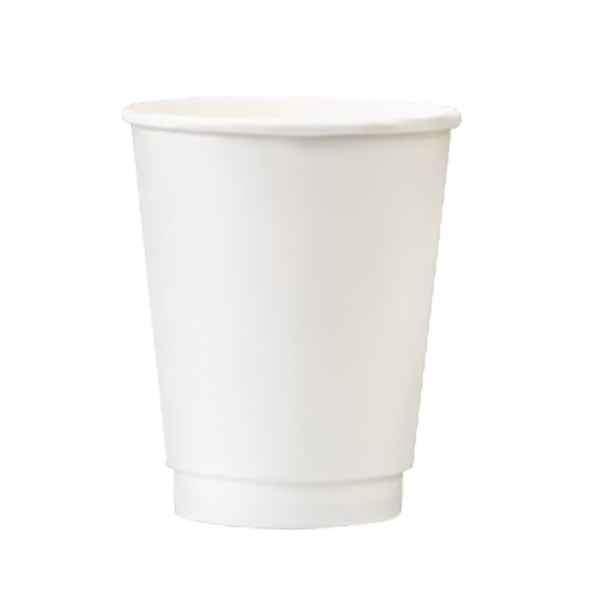
- The disposable double-layer paper cup is a 20oz format at 90×153×60mm, made from PE coated cup paper with double PE coating — the larger hot serve that is handed directly to the customer.
- The unprinted disposable hollow paper cup comes in 8oz, 12oz and 16oz at 80×92×56mm, 90×112×60mm and 90×135×60mm, in cup paper with PE coating — the standard café hot sizes.
- The printed disposable cold drink paper cup is an A3oz format at 62×62×42mm in PE coated paper, built for cold and iced service.
- The printed disposable beverage paper cup is offered at 9oz (75×87×53mm, double PE coated paper) and at 80oz (80×90×56mm, PE coated paper), while the custom disposable paper cup is a 20oz format at 90×153×60mm in double PE coated paper for branded programmes.
3.2 Insulation and the accessory line
Insulation is a cost line because it decides how many accessories travel with each drink. In general café practice, a single-layer hot cup is served with a sleeve or as a double cup so the customer can hold it comfortably. Double-layer and hollow-wall constructions add a second wall to the cup body; the purpose of that added wall is to reduce heat transfer to the hand, which is why these formats are commonly specified for hand-served hot drinks rather than for back-of-house prep.
For cold service the calculation runs the other way. A cold drink cup in PE coated paper is specified for cold beverages, where the barrier layer manages the drink and condensation rather than heat. Choosing the format that matches the service temperature removes accessory purchases from one side of the menu and leak risk from the other.
3.3 The compliance and end-of-life line
Compliance is only a cost when it is discovered late. A café that switches cup formats mid-year because the coating or the label does not meet the destination market's requirement pays twice: once for the stock it cannot use and once for the replacement. KingHonor's Vietnam factory holds BRCGS Packaging Materials certification C0691603-BRC4, and the company states that it prioritises recyclable and biodegradable raw materials to reduce environmental footprint — a first-party position worth reading alongside the QCVN 12-1:2011/BYT requirement in Vietnam and the EU 2019/904 coating transition.
4. Step-by-step: calculating cost per use for your café
Step 1 — Split the menu by service temperature. List every drink you sell and mark it hot or cold, then assign each one a format: single-layer for volume, double-layer or hollow for hand-served hot drinks, and a cold drink cup for iced service. A menu that mixes temperatures without matching formats creates accessory cost you never budgeted.
Step 2 — Count servings, not purchases. Sit at the counter for a day and record where cups actually go: sleeves used, double cups built, drinks remade, cups dropped or discarded. This is the denominator of the model, and it is the number suppliers never see.
Step 3 — Build the landed unit cost per size. Take the quoted unit price for each format and size, then add freight, duty and inland handling for your destination. Sizes must be costed separately: the 9oz beverage cup at 75×87×53mm and the 20oz double-layer cup at 90×153×60mm are not interchangeable in either volume or material content.
Step 4 — Add compliance and waste for your market. Confirm the food-contact conformity that applies where you sell — QCVN 12-1:2011/BYT in Vietnam, the EU 2019/904 labelling and coating transition in the European Union — and add your local waste handling rate. This is the line that most often separates two otherwise identical quotations.
Step 5 — Validate with a sample run before annual volume. Order the exact format and size, run it through a normal service day, and compare the two shortlisted options on hold time, lid fit, condensation and hand comfort. Only then convert the model into an annual order.
5. Where each format earns its place
Espresso and latte bar (hot, hand-served). The disposable double-layer paper cup at 20oz (90×153×60mm) and the disposable hollow paper cup at 8oz, 12oz and 16oz cover the standard hand-served range. Choosing a second-wall format here removes the sleeve from most hot drinks, which is a permanent saving rather than a one-off discount.
Iced beverage programme. The printed disposable cold drink paper cup at A3oz (62×62×42mm) in PE coated paper handles small cold serves, while the 9oz and 80oz disposable beverage paper cups extend the same barrier logic into larger cold drinks. Matching the cold cup to the cold menu keeps condensation-related remakes out of the denominator.
Branded multi-outlet chains. The custom disposable paper cup at 20oz (90×153×60mm, double PE coated paper) is the format for logo programmes, and KingHonor's listed equipment compatibility — cup lids, cup dispensers and custom printing equipment — means the branded cup stays compatible with the dispensing hardware a café already owns.
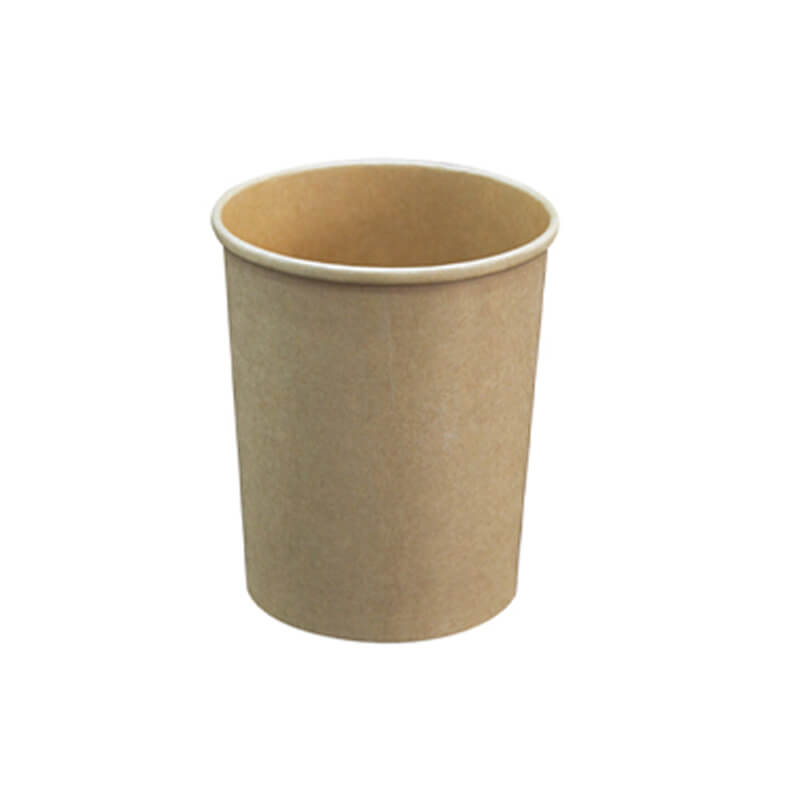
Soup and hot food add-ons. This is where the container changes the maths. Soup served in a beverage cup requires a lid that was not designed for it and a carrier that may not hold it. The Kraft Paper Soup Bucket ZT is offered in 8oz, 12oz, 16oz, 26oz and 32oz in kraft paper with PE coating, and for soup items it delivers better value than forcing a beverage format into a food application — the right container removes the accessory and remake lines entirely.
The same formats are specified across the channels a café sits inside: coffee shops, milk tea and beverage chains, fast food restaurants, large hotel groups, airline catering and business offices, all listed with room-temperature operation and cold/hot beverage compatibility. A café that later adds catering or office delivery can extend the same cup programme rather than rebuilding it.
6. Two comparison tables
The first table compares the paper cup formats a café actually chooses between. The second sets paper and plastic against the criteria that decide cost per use, and shows what must be verified on each side.
| Format | Model range | Size detail | Material | Where it earns its place |
|---|---|---|---|---|
| disposable single-layer paper cup (Plain Single-layer Paper Cup ZT) | 8oz, 10oz, 12oz, 16oz, 20oz, 24oz, 32oz, 44oz | Listed from 80×90×56mm to 115.5×189×83.5mm | Cup paper with PE coating | High-volume hot and cold beverage service with lids and sleeves in the counter setup |
| disposable double-layer paper cup | 20oz | 90×153×60mm | PE coated cup paper (double PE coated) | Larger hand-served hot drinks where the extra wall replaces a sleeve |
| disposable hollow paper cup (Unprinted Hollow Paper Cup ZT) | 8oz, 12oz, 16oz | 80×92×56mm, 90×112×60mm, 90×135×60mm | Cup paper with PE coating | Standard café hot sizes served without print customisation |
| disposable cold drink paper cup | A3oz | 62×62×42mm | PE coated paper | Small cold and iced serves where condensation control matters |
| disposable beverage paper cup | 9oz and 80oz | 75×87×53mm (9oz); 80×90×56mm (80oz) | Double PE coated paper (9oz); PE coated paper (80oz) | Everyday printed beverage service across hot and cold menus |
| custom disposable paper cup | 20oz | 90×153×60mm | Double PE coated paper | Branded programmes that require logo print at volume |
| Kraft Paper Soup Bucket ZT | 8oz, 12oz, 16oz, 26oz, 32oz | Specification lists models only | Kraft paper with PE coating | Soup and hot-food items where a beverage cup is the wrong container |
| Cost-per-use criterion | Disposable paper cup (as specified here) | Plastic cup — verify with your supplier |
|---|---|---|
| Food-contact conformity | QCVN 12-1:2011/BYT applies to packaging in direct food contact in Vietnam; KingHonor holds BRCGS Packaging Materials certification C0691603-BRC4 | Confirm the material declaration and the conformity document for your destination market |
| Barrier and leak performance | PE coated cup paper; café-facing specifications state food-grade, double PE coated, leak-proof | Confirm barrier performance and lid fit under your own service conditions |
| Insulation and hand service | Single-layer formats are typically served with a sleeve or as a double cup; double-layer (20oz) and hollow (8/12/16oz) formats add a second wall | Confirm whether a second-wall or sleeve option is offered, and at what additional cost |
| EU labelling and coating transition | Applies to beverage cups containing plastic — including PE-coated paper cups — under EU 2019/904, with transition to plastic-free coatings such as water-based barriers by 2026 | Same directive applies; confirm labelling and coating status for the market you sell in |
| Category reference point | Paper cups accounted for over 61% of global disposable cup sales in 2024 (Grand View Research) | Not covered by the verified data set used in this article — request supplier or market-specific evidence |
| Cost model applied | Unit cost + lids/sleeves + storage and handling + compliance and labelling + waste handling, divided by servings served | The same five-line model applies — compare like for like, not unit price against unit price |
7. FAQ
What food-contact compliance should a café check before buying disposable paper cups?
In Vietnam, packaging used in direct contact with food must comply with National Technical Regulation QCVN 12-1:2011/BYT, issued by the Ministry of Health, which covers synthetic resin implements and packaging in direct food contact. In the European Union, the Single-Use Plastics Directive (EU 2019/904) requires beverage cups containing plastic to carry the "Plastic in Product" label and to move toward plastic-free coatings such as water-based barriers by 2026 — a requirement that reaches paper cups with a PE coating as well as plastic cups. Ask for the certificate that covers the specific production site rather than a product-family claim; KingHonor's Vietnam factory holds BRCGS Packaging Materials certification C0691603-BRC4.
Which KingHonor paper cup formats fit hot drinks, and which fit cold drinks?
The range covers both sides of a café menu. For hot service, the plain disposable single-layer paper cup runs from 8oz to 44oz in cup paper with PE coating; the disposable double-layer paper cup is a 20oz format at 90×153×60mm in PE coated cup paper; and the unprinted disposable hollow paper cup comes in 8oz, 12oz and 16oz at 80×92×56mm, 90×112×60mm and 90×135×60mm. For cold service, the printed disposable cold drink paper cup is an A3oz format at 62×62×42mm in PE coated paper, while printed disposable beverage paper cups are offered at 9oz (75×87×53mm, double PE coated paper) and 80oz (80×90×56mm, PE coated paper). Branded programmes use the 20oz custom disposable paper cup at 90×153×60mm in double PE coated paper.
How do I compare cost per use between a paper cup and a plastic cup?
Apply five cost lines to one denominator: (cup unit cost + lids, sleeves and carriers + storage and handling + compliance and labelling + waste handling) ÷ servings actually served. The denominator must reflect what happens at the counter — sleeves, double-cupping, discarded drinks and remakes — not the number of cups purchased. This article deliberately publishes no per-unit price, because prices depend on order volume, print coverage, freight and destination duty; the calculation model itself is what transfers between suppliers and between markets.
Can a café test cups before committing to a volume order?
Yes, and for café service it is the only reliable way to close the accessory and remake lines of the cost model. Test the exact format and size you intend to order under your own conditions: how a hot drink holds in the hand in a single-layer versus a double-layer or hollow cup, whether the lid seats and stays seated, and how a cold drink cup behaves with condensation. KingHonor's formats, models and sizes are listed in its product brochure, which can be downloaded before you request samples.
What information does a supplier need to quote accurately and confirm lead time?
Prepare six inputs: the cup formats and sizes you want (for example, single-layer 12oz, double-layer 20oz and cold drink A3oz); the split between hot and cold service; your monthly or annual volume per size; whether you need custom logo printing; your destination market and the compliance or labelling requirements that apply there; and your preferred port or delivery point. With those inputs, KingHonor can quote on the specific formats rather than on a generic cup. Contact Mr. Yang at info@kinghonorpack.com, by telephone at +86 13918832889, or on WhatsApp at +8618205730716, and download the product brochure here: KingHonor product brochure.
8. Conclusion: choose the format that deletes cost lines
A café's cup decision resolves into one rule: pick the format that removes cost lines, not the one with the lowest unit price. A single-layer cup with a sleeve carries three purchases per drink; a double-layer or hollow cup carries one. A cold drink served in the correctly specified cup avoids the condensation remake. A soup item served in a Kraft Paper Soup Bucket ZT avoids a lid and carrier that were never designed for it. Add the compliance line — QCVN 12-1:2011/BYT where you sell in Vietnam, the EU 2019/904 labelling and coating transition where you sell in the European Union — and the comparison becomes defensible rather than anecdotal.
KingHonor Paper Products Co., Limited Liability Company is a Vietnam-based manufacturer of disposable paper cups, paper bowls and paper food containers, founded in 2018, operating a 50,000m² factory with more than 200 employees, an R&D team of 20 core technical staff, and annual output of 20,000 tons of food-grade PE coated paper and over 2 billion paper cups and paper food containers. The company exports 60% of production to the United States, China, Europe, Australia and the Middle East, alongside its wider range of paper bowls, food containers and boat-shaped boxes.
Next step: cost your own cup programme on real numbers
Send KingHonor your hot and cold format split, monthly volumes and destination market, and request samples of the exact formats you are comparing — single-layer, double-layer, hollow or cold drink. The product brochure lists the full model and size range across the disposable paper cup, bowl and food container lines.
Email: info@kinghonorpack.com · Tel: +86 13918832889 · WhatsApp: +8618205730716 · Website: www.kinghonorpack.com
Factory address: Binh Tien 2 Hamlet, Duc Hoa Ha Commune, Duc Hoa District, Long An Province, Vietnam.
Download the brochure: KingHonor product brochure (PDF/DOCX)
Have Questions or Need More Details?
Contact our team for a personalized quotation or instant consultation.
Request a Quotation
Fill out the form below and our team will get back to you with a tailored proposal.
WhatsApp Direct Chat
Prefer to chat in real-time? Message us on WhatsApp for instant assistance & quick answers.
- Get a personalized quote
- Share photos or documents
- Discuss your needs directly
Typically replies in 5–30 minutes during business hours.