Single-Layer vs Double-Layer vs Hollow Paper Cups: A Buyer's Comparison Guide for Beverage Programs
Three cup constructions dominate disposable beverage service: the disposable single-layer paper cup, the disposable double-layer paper cup and the disposable hollow paper cup. The working rule is short enough to state at the start. Use single-layer where unit cost and short holding time dominate; use double-layer where a hot drink needs a comfortable outer wall and full-surface brand printing; use hollow where the program needs an insulating air layer without handing out a separate sleeve. Everything after that rule is specification, sampling and purchasing discipline.
This guide compares formats, not suppliers. It maps each construction to the beverage programs it normally serves, records which sizes are actually available from KingHonor, and sets out the checks a buyer should complete before a beverage program commits to one format for a full season.
Why Cup Format Is a Procurement Decision, Not a Design Preference
Catalog photographs make the three formats look interchangeable. Operationally they are not. A cup's wall construction determines how much board goes into each unit, how the outside surface feels in a customer's hand, how much of the cup can carry artwork, and how the printed result must be specified and approved.
Buyers who skip the format decision usually hit one of three failures:
- Quotation comparison without a normalized specification. Single-layer, double-layer and hollow quotations are not comparable unless cup size, board and coating, print coverage, packing configuration and minimum order quantity are stated identically on all three.
- Artwork locked before the drink matrix. A design approved for a smooth single-layer wall does not transfer automatically to a hollow wall, where the embossed outer surface changes how fine detail and large solid areas read.
- Compliance treated as paperwork after the purchase order. Vietnam introduced new testing and registration requirements for food-contact packaging in 2026, so a format decision made without the test and declaration dossier in hand is a decision that can stall at the customer's audit or at the border.
There is a cost dimension too. Because the three formats consume different amounts of board and require different forming steps, unit price differences are structural rather than commercial. Changing format after approval typically restarts sampling and print approval, so the format decision is best made once, with evidence, at the evaluation stage.
What the Vietnam Supply Base and the Global Product Mix Tell You
Vietnam has become a relevant sourcing base for disposable beverage paper cups, and the published numbers explain why buyers keep reopening the format question. IMARC Group estimates the Vietnam paper cup market at USD 41.5 million in 2025 and projects USD 57.9 million by 2034. The Vietnam Packaging Association reported annual growth of 20–25% for the country's paper cup manufacturing industry between 2022 and 2024, with 2022 domestic consumption estimated at 4.2 billion units against 1.2 billion units exported.
The global product mix is equally instructive. Mordor Intelligence places poly-coated paper cups at 62% of the global market and air-pocket insulated (double-layer) cups at 18%. That tells a buyer two things: the coated single-wall cup remains the volume default, and insulated constructions are a meaningful but specialised segment. Published taxonomies also disagree on terminology, with some sources grouping ripple and hollow cups under “air pocket insulated” and others filing them separately. Confirm construction from the physical sample and the supplier's specification sheet, not from a category label in a market report.
Regulation is the third backdrop. Resolution No. 66.13/2026/NQ-CP, effective 16 April 2026, introduces new testing and registration requirements for food-contact packaging in Vietnam. TCVN 12723:2019 addresses food-contact paper and paperboard and is listed by Eurofins Vietnam among the standards applied to packaging and food-contact materials. A legal analysis published by Nishimura & Asahi describes self-declaration before domestic circulation for food-contact utensils, packaging and containers, supported by food-safety testing results from a designated or ISO 17025-qualified laboratory. None of this decides which format you buy — but it does decide which supplier can hand you a complete dossier for the format you choose.
How the Three Constructions Actually Differ
KingHonor Paper Products Co., Ltd. is a disposable paper cup, paper bowl and food container manufacturer founded in 2018, headquartered in Ho Chi Minh City, Vietnam, with its plant at Binh Tien 2 Hamlet, Duc Hoa Ha Commune, Duc Hoa District, Long An Province. The company operates a 50,000 m² factory with 200+ employees and 20 core technical staff, and reports annual output of 20,000 tons of food-grade PE coated paper plus over 2 billion paper cups and paper food containers, with roughly 60% of output exported to the United States, China, Europe, Australia and the Middle East. Its cup range covers all three constructions discussed here, which makes it a practical reference for what each format looks like as a purchasable specification.
Disposable single-layer paper cup
A disposable single-layer paper cup is one paperboard wall with a food-contact coating, formed into a tapered cup with a rolled rim and a base. The coating is typically PE, with PLA available as a coating option within KingHonor's certified scope. The outside of that single wall is also the print surface, so artwork sits directly on the structural wall.
For a beverage program this is the leanest format in material terms and the simplest to print across the full surface. What it lacks is a second wall between the drink and the customer's hand. For short-hold service, where a drink is consumed within minutes, that is often acceptable; for long-hold hot drinks it usually is not, which is where a sleeve or a second wall enters the specification.
KingHonor offers its disposable single-layer paper cup in 8oz, 10oz, 12oz, 16oz, 20oz, 24oz, 32oz and 44oz. The range also includes a disposable beverage paper cup in 9oz and 80oz and a disposable cold drink paper cup in A3oz.
Disposable double-layer paper cup
A disposable double-layer paper cup carries a second paper wall bonded outside the first, leaving an air gap between the drink-side liner and the outer surface. The outer wall is smooth and printable, and because the hand contacts that outer wall rather than the liner, the cup can be served without a separate sleeve.
For a beverage program, double-layer buys comfort and print area at the same time. Two walls mean more board per unit and an additional forming step, both of which appear in the quotation. That is why double-layer usually enters a program at the hot-beverage or premium tier rather than as the default for every SKU in the range.
KingHonor offers its disposable double-layer paper cup in 20oz, and the custom disposable paper cup range includes a 20oz format.
Disposable hollow paper cup
A disposable hollow paper cup uses an outer layer formed with a pattern of air pockets — an embossed or corrugated wall that stands off the liner — so insulation comes from trapped air rather than from a second smooth wall. The outer surface is textured rather than flat.
For a beverage program, hollow construction addresses the hot-drink hand-feel problem without a separate sleeve and without the smooth outer wall of a double-layer cup. The trade-off sits on the print side: artwork has to work with the embossed surface, so fine detail and large solid panels should be evaluated on a physical printed sample rather than on a PDF proof.
KingHonor offers its disposable hollow paper cup in 8oz, 12oz and 16oz.
Custom disposable paper cup: what changes across formats
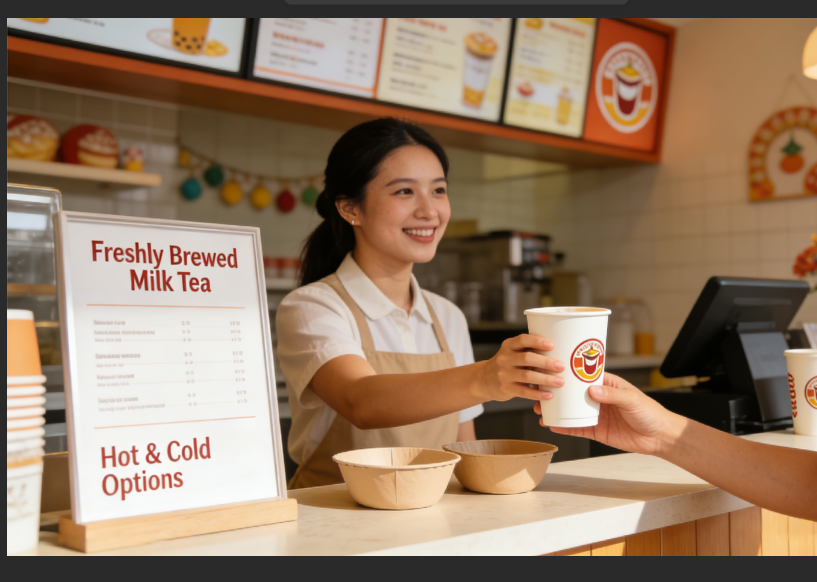
Customization at KingHonor covers logo, cup size, cup color and cup material, with flexographic printing inside a BRCGS-certified scope that also covers coating with polyethylene (PE) or poly lactic acid (PLA) resin, die-cutting of paper board and forming of paper cups and lids, boxes, trays and bowls for food service.
Format choice changes three things in a custom program: how much printable area is available, how the print must be specified against the surface (flat outer wall versus embossed hollow wall), and how artwork is confirmed before mass production. KingHonor runs pre-production confirmation for custom designs specifically to reduce that error class, and offers a dedicated point of contact with transparent, traceable order status throughout the process.
Side-by-Side Comparison of the Three Formats
| Comparison criterion | Disposable single-layer paper cup | Disposable double-layer paper cup | Disposable hollow paper cup |
|---|---|---|---|
| Wall construction | One coated board wall formed into a cup | Inner liner plus a smooth outer wall bonded outside it, with an air gap | Inner liner plus an embossed outer layer formed with air pockets |
| Where the insulation comes from | Board and coating only; a sleeve is normally added for long-hold hot drinks | Air gap between two walls plus the standoff of the outer wall | Air trapped in the embossed pocket structure |
| Outer surface for printing | Smooth, flat | Smooth, flat | Embossed, textured |
| Artwork consideration | Full-surface flat print; fine detail reproduces predictably | Full-surface flat print on the outer wall; large solids feasible | Detail and solid panels must be proofed on the textured surface before approval |
| Sleeve needed for hot, long-hold service | Typically yes | No | No |
| Sizes offered by KingHonor | 8oz, 10oz, 12oz, 16oz, 20oz, 24oz, 32oz, 44oz; plus 9oz and 80oz disposable beverage paper cup and A3oz disposable cold drink paper cup | 20oz | 8oz, 12oz, 16oz |
| Typical program fit (validate with samples) | Cold drinks, iced and short-hold service, high-volume value SKUs, wide size ladders | Hot beverage programs that want hand comfort plus brand-heavy cups | Hot beverage programs that want insulation without a separate sleeve |
| What the sample test should focus on | Seam and base integrity after filling, print registration, rim condition | Bond between the two walls, rim and base integrity, artwork alignment to the seam | Consistency of the embossed pattern, legibility of print on texture, hand-feel at service temperature |
Comparison reflects KingHonor product data and general construction differences between the three formats. Confirm all values against the approved sample and the supplier's specification sheet.
Three decision rules for beverage programs. First, if the drink matrix contains long-hold hot drinks and the operation does not want to manage sleeves, exclude single-layer from those SKUs. Second, if the brand relies on large solid colour panels or fine logo detail across the full cup, prefer a smooth outer wall and test the hollow option only with a printed sample in hand. Third, if the size ladder must reach 24oz and above, confirm availability per format before the design is finalised — KingHonor's hollow range stops at 16oz while the single-layer range extends to 44oz.
A Seven-Step Selection Process for Beverage Programs
Step 1 — Build the drink matrix before the cup list
List every SKU the program will serve and record four attributes for each: serving temperature, serving size, expected holding time, and whether the customer consumes on premises or takes the drink away. The format decision is made from this matrix, not from a cup catalogue.
Step 2 — Express the insulation requirement in service terms
“Insulated cup” is not a specification. “12oz hot drink, consumed within roughly fifteen minutes, served without a sleeve” is. Written this way, the requirement immediately separates single-layer (needs a sleeve), double-layer (no sleeve, smooth outer wall) and hollow (no sleeve, textured outer wall).
Step 3 — Decide print coverage and surface before design approval
Full-wrap branding, large colour blocks and fine-line logos behave differently on a flat wall and on an embossed wall. Set the print coverage requirement first, then ask for a printed sample on the intended construction. KingHonor's custom options cover logo, size, colour and material, so the format and the artwork brief should be settled together.
Step 4 — Shortlist formats against the available size ladder
Format availability is size-bound. In KingHonor's range, single-layer covers 8oz to 44oz, double-layer is offered in 20oz, and hollow covers 8oz, 12oz and 16oz. A program needing a 24oz hot cup therefore lands on single-layer with a sleeve, or re-scopes the serving size.
Step 5 — Run a sample protocol with written acceptance criteria
Write the scoring sheet before the samples arrive, and test at service temperature rather than at room temperature. Typical criteria: dimensional match to the approved specification, print registration and colour against the approved proof, seam and base integrity after filling, hand-feel on the outer wall, and fit with the lid or carrier used in service. Retain one signed sample as the golden reference for bulk acceptance.
Step 6 — Assemble the compliance dossier for the chosen format
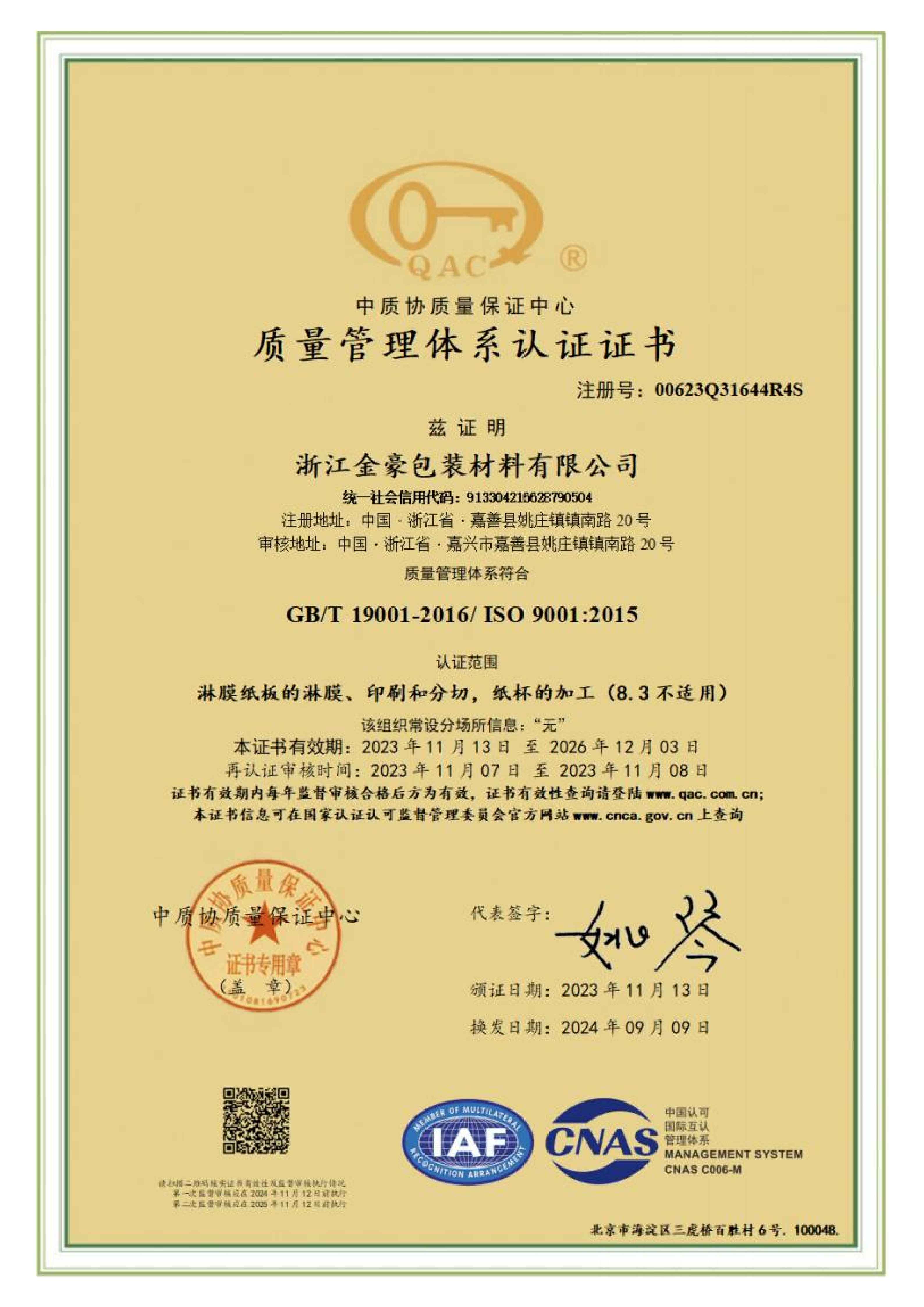
Request certificates and test reports matched to the specific construction and coating, and check the dates on every document. KingHonor holds an FSC Chain of Custody Single Certificate, number ESTS-COC-250653, issued by ESTS on 5 June 2025 and valid until 4 June 2030, covering printing and sales of FSC Mix paper products. Its BRCGS Global Standard Packaging Materials certificate, number C0691603-BRC4, was issued by NSF Certification, LLC on 20 April 2025 with a stated expiry of 1 June 2026, so buyers evaluating in late 2026 should request the current version rather than rely on a document already on file. The ISO 9001 certificate 00623Q31644R4S and ISO 14001 certificate 00623E31318R4S, both issued by QAC on 13 November 2023, carry an expiry of 3 December 2026.
Step 7 — Lock commercial terms and the acceptance clause
Convert the sample agreement into purchase terms: minimum order quantity, delivery schedule, inspection method, and what happens if a batch fails. KingHonor quotes a minimum order of 100,000 pieces and a monthly capacity of 1,666 tons, with on-time delivery, multi-level and multi-dimensional quality inspection, free replacement or return and exchange for quality issues, fast claim and replacement for logistics damage, and pre-production confirmation for custom designs.
Which Format Fits Which Beverage Program
Hot beverage programs: cafés, offices, hotels, airlines
Where a hot drink is carried by hand for more than a few minutes and no sleeve is offered, the choice narrows to double-layer or hollow. Double-layer gives the widest print freedom on a smooth wall; hollow gives insulation on a textured wall. KingHonor reports supplying 10 million disposable paper cups per month to internationally renowned airlines for beverage service, and 10 million disposable paper cups per month to well-known hotel chains, in both cases with customised logo printing for brand promotion.
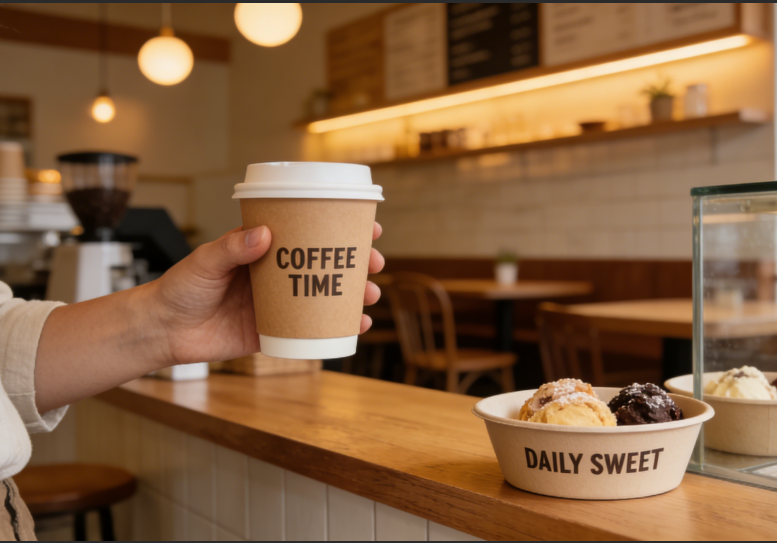
Cold drink programs: iced coffee, milk tea, juice
Cold and iced drinks rarely need wall insulation; the governing requirements are leak resistance, a stable size ladder and cost per unit. Coated single-layer cups dominate here, supported by dedicated cold-drink formats such as the A3oz disposable cold drink paper cup. KingHonor reports supplying 10 million disposable paper cups per month to a national milk tea chain for in-store beverage sales and takeaway packaging.
Branded custom programs: quick service, hospitality, retail
When the cup is a brand asset, print surface becomes a selection criterion in its own right. A custom disposable paper cup program should fix the format, size, print coverage and approval workflow together, because the artwork proof only means something once the substrate is decided. Across its reported case files — airlines, fast food chains, milk tea chains and hotel groups — KingHonor states that customised logo printing supported brand promotion and that eco-friendly materials helped clients reduce packaging costs by 15%.
Programs that also ship food alongside the drink
Most beverage accounts eventually add food. KingHonor's range extends beyond cups to a disposable paper bowl in 500, 700, 900, 1000, 1100, 1300 and 1500 sizes, a disposable food container in No.1 to No.5 and No.8 square boxes, a disposable paper food container in 500, 600, 850, 960 and 1100 sizes, disposable boat-shaped boxes from #025 to #1000, and a kraft paper soup bucket in 8oz, 12oz, 16oz, 26oz and 32oz. Consolidating cups, bowls and containers under one specification and one quality system reduces the number of approval cycles a beverage program has to run.
FAQ: Format, Compliance, Cost, Samples and Lead Time
1. What food-contact documentation should a buyer collect before ordering paper cups for a Vietnamese beverage program?
Start with the regulatory baseline, then request documents specific to the chosen cup construction and coating. Resolution No. 66.13/2026/NQ-CP, effective 16 April 2026, introduces new testing and registration requirements for food-contact packaging in Vietnam. TCVN 12723:2019 covers food-contact paper and paperboard and is listed by Eurofins Vietnam among the standards applied to packaging and food-contact materials, while a Nishimura & Asahi legal analysis describes self-declaration before domestic circulation supported by food-safety testing from a designated or ISO 17025-qualified laboratory. In practice, ask for test reports covering the specific cup and coating, evidence of declaration where applicable, and current certificates with visible expiry dates.
2. Can one supplier cover single-layer, double-layer and hollow formats plus custom printing?
At KingHonor, yes. The range includes a disposable single-layer paper cup in 8oz, 10oz, 12oz, 16oz, 20oz, 24oz, 32oz and 44oz, a disposable double-layer paper cup in 20oz, a disposable hollow paper cup in 8oz, 12oz and 16oz, a 9oz and 80oz disposable beverage paper cup, an A3oz disposable cold drink paper cup, and a 20oz custom disposable paper cup. Customization covers logo, size, colour and material. The BRCGS scope covers PE or PLA coating, flexographic printing, die-cutting and forming of paper cups and lids, boxes, trays and bowls, and the company reports monthly capacity of 1,666 tons supported by 20 core technical staff.
3. What drives the cost difference between single-layer, double-layer and hollow cups?
No verified public price series exists for these formats, so treat any quotation as comparable only when the specification is identical. Itemize the variables that actually move unit price: board content per unit (one wall versus two walls versus an embossed outer layer), coating type (PE versus PLA), print coverage and number of colours, minimum order quantity, packing configuration, and delivery terms. KingHonor quotes a minimum order of 100,000 pieces, so ask every supplier to price the same size, the same print coverage and the same carton count before you compare totals.
4. How should a beverage program evaluate samples across three formats?
Score samples against written criteria rather than impressions. Fill each format at its intended service temperature, check seam and base integrity, assess hand-feel on the outer wall, verify print registration and colour against the approved proof, and confirm fit with the lid or carrier used in service. Retain one signed sample per format as the golden reference for bulk acceptance. KingHonor supports this by running pre-production confirmation for custom designs to reduce errors before mass production.
5. What minimum order quantity and lead time should a beverage program plan for?
KingHonor operates a minimum order of 100,000 pieces with a monthly capacity of 1,666 tons, on-time delivery, a dedicated point of contact with transparent and traceable order status, free replacement or return and exchange for quality issues, and fast claim and replacement for logistics damage. Because capacity is shared across formats, the size ladder and print coverage should be confirmed at the quotation stage rather than assumed. To move from evaluation to a decision, request a sample set in the shortlisted formats or a quotation matched to your drink matrix through kinghonorpack.com, or download the product brochure below and send your specification to info@kinghonorpack.com.
Conclusion
The format decision resolves faster once it is separated into three questions. Does the drink require insulation in the customer's hand, and will the operation accept a sleeve? Does the brand require flat, full-surface print or can it work with a textured wall? And does the size ladder need to reach beyond 16oz? Single-layer answers cost and cold-drink volume; double-layer answers comfort plus print freedom; hollow answers insulation without a sleeve.
What remains is evidence. Normalize the specification, test printed samples at service temperature, and check that the compliance dossier is current for the exact construction you are buying. That sequence is what turns a format preference into a beverage program that survives a full season without re-specification.
Next step: sample set or quotation
KingHonor Paper Products Co., Ltd. manufactures disposable single-layer, double-layer and hollow paper cups, custom printed cups, paper bowls, food containers and boat-shaped boxes from its Vietnam facility, with FSC Chain of Custody certification ESTS-COC-250653, BRCGS certification C0691603-BRC4, ISO 9001 certificate 00623Q31644R4S and ISO 14001 certificate 00623E31318R4S on file.
Send your drink matrix, target sizes and print coverage to request a matched sample set or a quotation. Brochure: KingHonor product brochure (download). Website: www.kinghonorpack.com. Email: info@kinghonorpack.com. Contact: Mr. Yang, Tel +86 13918832889, WhatsApp +8618205730716. Address: Binh Tien 2 Hamlet, Duc Hoa Ha Commune, Duc Hoa District, Long An Province, Vietnam.
Have Questions or Need More Details?
Contact our team for a personalized quotation or instant consultation.
Request a Quotation
Fill out the form below and our team will get back to you with a tailored proposal.
WhatsApp Direct Chat
Prefer to chat in real-time? Message us on WhatsApp for instant assistance & quick answers.
- Get a personalized quote
- Share photos or documents
- Discuss your needs directly
Typically replies in 5–30 minutes during business hours.