Solving Takeaway Grease Leaks: PE-Coated Paper Containers for Fast Food Brands
Takeaway packaging · Barrier performance · Buyer guide
A grease halo spreading across a delivery bag, or a box bottom that turns translucent and soft before the customer opens it, is not a cosmetic defect. It is a complaint ticket, a refund, and often a menu item that gets quietly removed from the delivery list. Grease leaks in paper takeaway packaging are a materials problem before they are a packaging problem — and the fix is usually not a thicker box, but a properly specified polyethylene (PE) barrier on the food-contact surface.
This guide explains the four places where paper containers actually fail, why PE-coated kraft paper changes the failure mode, and how three production formats from KingHonor Paper Products Co., Ltd. — Kraft Paper Square Box XQ, Kraft Paper Bowl ZT and White Kraft Food Tray ZT — map to fast food, catering and beverage-chain takeaway operations.
The real failure points: where takeaway grease leaks begin
Most grease leaks are not caused by the paper being “too thin”. They are caused by oil or hot liquid reaching a part of the container where the barrier is interrupted. In a paper food container there are four such points, and they fail for different reasons.
- The base seam. The bottom disc is folded and pressed into the side wall. If the coating is not continuous across the fold, oil migrates into the exposed fibre and the seam gradually separates under weight.
- The side-wall overlap. The longitudinal seam is a double-thickness zone. It is rigid, but it is also a wicking path if the coating does not bridge the overlap cleanly.
- The rim. The rolled top edge is where a customer’s fingers, a lid, and a sauce-covered spoon all meet. A saturated rim loses shape before the body does.
- Fold lines and corners. The sharper the geometry — square corners, boat-tray creases — the more the coating is stretched, and the more likely a micro-channel forms.
Two mechanisms drive all four: wicking and softening. Wicking is capillary absorption of oil into the cellulose fibre. Softening is what happens once moisture and heat plasticise the paper — the container does not necessarily leak visibly, it simply stops holding its shape, and then it leaks under stacking load.
Oil-proof and waterproof are two separate tests
A container that survives a hot broth is not automatically validated for fried food, and the reverse is also true. Water-based tests exercise the coating’s water resistance; oil-based tests exercise its grease resistance. A mixed menu item — a saucy protein with an oil-based dressing, packed hot and held for 30 minutes in a delivery bag — exercises both at the same time, plus heat. Many “leak” complaints trace back to a container that was approved on one test and deployed on the other.
Buyer rule of thumb: validate the container against the specific menu item it will carry, at the temperature it leaves the kitchen, for the longest delivery window you actually serve. A generic “leak-proof” claim from any supplier is not a substitute for that test.
Industry background: why paper containers are now judged on barrier construction
Paper is no longer a niche material in takeaway packaging, and buyers increasingly compare suppliers on coating and seam construction rather than on print quality alone.
Verified market reporting places the global takeaway containers market at USD 15.8 billion in 2024, with paper and paperboard holding a 31% share — roughly USD 4.90 billion — against plastic at 43%, bioplastics at 15% and aluminium at 11% (Verified Market Reports, 2026). Separately, the paper and paperboard segment of food packaging is projected to grow at a 6.2% CAGR between 2026 and 2034 (Grand View Research). The practical reading for a fast food brand is straightforward: paper takeaway volume is expanding, so the cost of a barrier failure scales with the volume.
Supply is also global, which is precisely why specifications have to be written down. In 2024 the United States imported USD 3.61 billion in paper containers, with China as the second-largest supplier at USD 858 million (Observatory of Economic Complexity). A brand buying from several regions will receive containers that look identical and behave differently, because base paper, coating coverage and seam design differ.
Coating choice has become a compliance question as well as a performance question. KingHonor states that its products can be produced with PE coating or PLA coating for oil-proof, waterproof and heat insulation performance (company-reported). That means a buyer can specify the barrier chemistry, not just the container shape — and should record which one was approved.
The solution: what a PE coating actually does, and the three formats that carry it
Polyethylene is applied as a continuous film on the food-contact side of the paperboard. Because the film has a low surface energy, oil beads on it instead of wetting into the fibre, and water does not penetrate the cellulose. The substrate underneath stays dry, so it keeps its stiffness for the duration of the delivery window. That is the whole mechanism — and it explains why coating continuity, not paper weight, is the variable that decides whether a container leaks.
KingHonor’s certification scope is relevant here. The BRCGS Global Standard Packaging Materials certificate C0691603-BRC4, issued by NSF Certification, LLC, covers “coating with polyethylene (PE) or poly lactic acid (PLA) resin, flexographic printing, die-cutting of paper board and forming of paper cups and lids, boxes, trays, and bowls for food service.” In other words, coating, printing and forming sit inside one audited scope rather than being split across unrelated subcontractors.
Kraft Paper Square Box XQ — kraft paper with PE coating
Kraft Paper Square Box XQ is built on kraft paper with PE coating and is offered in No.1, No.2, No.3, No.4, No.5 and No.8 Square Box sizes. The documented application sectors are major hotel groups, beverage chains, fast food chains and airlines. The square format gives vertical walls and a flat base, which is what you want for stacked rice, protein-plus-side meals and multi-item combos: the load path runs straight down the wall rather than through a curve, and the flat base sits stable on a delivery bag floor.
Kraft Paper Bowl ZT — kraft paper with PE coating, round geometry
Kraft Paper Bowl ZT uses the same kraft paper with PE coating and is available in models 500, 700, 900, 1000, 1100, 1300 and 1500. Documented dimensions across the range include 150×128×60 mm, 180×160×51 mm, 150×128×75 mm, 165×145×66 mm, 180×160×65 mm and 185×160×65 mm. The round body has no corner creases, which removes one of the four failure points entirely — this is why bowls are the safer default for wet, sauce-heavy and broth-bearing items. It is also specified for hotel groups, beverage chains, fast food chains and airlines.
White Kraft Food Tray ZT — coated white cardboard, boat-shaped
White Kraft Food Tray ZT is a boat-shaped tray made from coated white cardboard, offered in models #025, #040, #050, #100, #200#, #250, #300, #500 and #1000, with a documented application focus on catering and food takeaway. Two things make it the right recommendation for catering-style service: coated white cardboard gives a brighter, cleaner print surface than brown kraft, which matters when the tray doubles as a serving vessel; and the low, open boat profile suits handheld and snack-format items where a tall box would be awkward.
Specification note: the recorded material for White Kraft Food Tray ZT is coated white cardboard. Coating chemistry is confirmed per SKU at quotation — do not assume the tray carries the same PE specification as the kraft box or bowl unless it is stated on the specification sheet for that model.
Step-by-step: specifying a leak-resistant PE-coated container
The sequence below is written for a brand moving from evaluation into execution — that is, from “which format?” to a locked specification and a repeatable order.
Step 1 — Classify every menu item by leak risk
Split the menu into three groups: free-oil items (fried chicken, pastries, oil-dressed sides), wet items (curries, stews, broth noodles, sauces), and mixed hot items (a protein plus sauce plus a starch). Assign each item a maximum hold time. This classification, not the container catalogue, determines the format.
Step 2 — Choose the geometry before the decoration
Square box for stacked, multi-component meals. Round bowl for wet and sauce-heavy dishes, because it removes the corner-crease failure point. Boat-shaped tray for catering and handheld service. Choosing print before geometry is the most common cause of a second order.
Step 3 — Write the barrier into the specification
State the coating type explicitly: PE coating on the food-contact side, or PLA if the brand requires it — KingHonor states both are available. Ask for the coating specification and the test method behind any oil-proof or waterproof claim, and record the answer in the purchase specification rather than in an email thread.
Step 4 — Specify closure and stacking behaviour
Define whether the container needs a lid, how high the fill line sits below the rim, and how many units stack in a delivery bag. Rim saturation and overfilling above the seam account for a large share of complaints that get misattributed to the paper.
Step 5 — Confirm print and branding
Customized logo printing is a documented service feature across KingHonor’s disposable packaging range, available for both paper cups and food containers, and used by beverage chains and fast food chains for brand promotion. Flexographic printing sits inside the BRCGS certified scope, which is useful if your brand team needs the print process to be auditable.
Step 6 — Run a three-part validation with your own food
First, a hot-fill hold: pack the actual menu item at service temperature and hold it for your longest delivery window. Second, a transit test: stack and shake as a rider would. Third, a tip test: lay the container on its side for several minutes. Inspect base seam, side seam, rim and corners after each stage. A container that passes all three on your food is validated; one that passes a supplier’s generic test is not.
Step 7 — Lock the compliance file
Attach current certificates to the purchase specification and note their validity windows (see the table below). Certificate dates roll over, so re-confirm status at each annual review rather than at the first order only.
Step 8 — Scale with a volume plan
KingHonor operates a 50,000 m² facility with 200+ employees, 20 core technical staff, and an annual output of 20,000 tons of food-grade PE coated paper plus over 2 billion paper cups and paper food containers. Documented client volumes reach 10 million units per month. Plan the ramp against those figures and confirm SKU-level lead time at quotation.
Use cases: how the formats behave in real operations
Fast food chains
KingHonor supplies 10 million disposable food containers per month to well-known fast food chains, used for food and beverage sales and takeaway packaging at top-five national fast food chains, with operations spanning multiple countries including the US, Vietnam, China and others. In that case the client achieved a 15% reduction in packaging costs using eco-friendly materials, and customized logo printing was part of the programme. For a chain at this volume, the grease-leak question is a specification-discipline question: one approved barrier specification, applied across every SKU, is what keeps complaint rates flat as menu items are added.
Milk tea and beverage chains
A national milk tea chain is supplied at 10 million disposable paper cups per month for in-store beverage sales and takeaway packaging, with the same reported 15% packaging cost reduction and customized logo printing. Beverage-led counters are a useful stress case, because an order frequently pairs a hot drink with an oil-bearing snack — two different barrier requirements in one bag.
Airline catering
KingHonor supplies 10 million disposable paper cups monthly to internationally renowned airlines, for beverage service and use by top-five national airlines, again with a reported 15% packaging cost reduction and customized logo printing. Airline service adds a constraint that takeaway does not: trays are handled, stacked and cleared under time pressure, so rim integrity matters as much as base integrity.
Catering and food takeaway
For catering-style service — buffets, event catering, office lunch programmes, pastry and snack counters — White Kraft Food Tray ZT is the format fit: a boat-shaped coated white cardboard tray in nine sizes from #025 to #1000, documented for catering and food takeaway. The open profile allows fast filling, and the white surface presents cleanly when the tray goes straight onto a table.
Comparison table: three PE and coated formats side by side
The table below uses only documented product data. It is a format-selection aid, not a ranking — the correct choice depends on the menu item and the delivery window.
| Attribute | Kraft Paper Square Box XQ | Kraft Paper Bowl ZT | White Kraft Food Tray ZT |
|---|---|---|---|
| Material | Kraft paper with PE coating | Kraft paper with PE coating | Coated white cardboard |
| Documented models | No.1, No.2, No.3, No.4, No.5, No.8 Square Box | 500, 700, 900, 1000, 1100, 1300, 1500 | #025, #040, #050, #100, #200#, #250, #300, #500, #1000 |
| Geometry | Square, vertical walls, flat base | Round bowl body | Boat-shaped tray, low open profile |
| Documented dimensions | Confirmed per model at quotation | Range includes 150×128×60 mm, 180×160×51 mm, 150×128×75 mm, 165×145×66 mm, 180×160×65 mm, 185×160×65 mm | Confirmed per model at quotation |
| Documented application sectors | Hotel groups, beverage chains, fast food chains, airlines | Hotel groups, beverage chains, fast food chains, airlines | Catering, food takeaway |
| Barrier note | PE coating on food-contact side; coating continuity at corners and base seam is the deciding factor | PE coating on food-contact side; round geometry removes corner creases | Coating chemistry confirmed per SKU; verify against oil-based items before approving |
| Typical operational fit | Stacked multi-component meals and combos | Saucy, wet and broth-bearing items | Catering service, buffets, snack and pastry counters |
Compliance reference: certificates on file
| Certificate | Number | Issuer | Scope | Recorded validity |
|---|---|---|---|---|
| ISO 9001:2015 Quality Management System | 00623Q31644R4S | QAC | Lamination, printing and slitting of laminated paperboard, processing of paper cups | Issued 2023-11-13, expiry 2026-12-03 |
| ISO 14001:2015 Environmental Management System | 00623E31318R4S | QAC | Lamination, printing and slitting of laminated paperboard, processing of paper cups | Issued 2023-11-13, expiry 2026-12-03 |
| BRCGS Global Standard Packaging Materials | C0691603-BRC4 | NSF Certification, LLC | PE or PLA coating, flexographic printing, die-cutting, forming of cups, lids, boxes, trays and bowls for food service | Issued 2025-04-20, expiry 2026-06-01 |
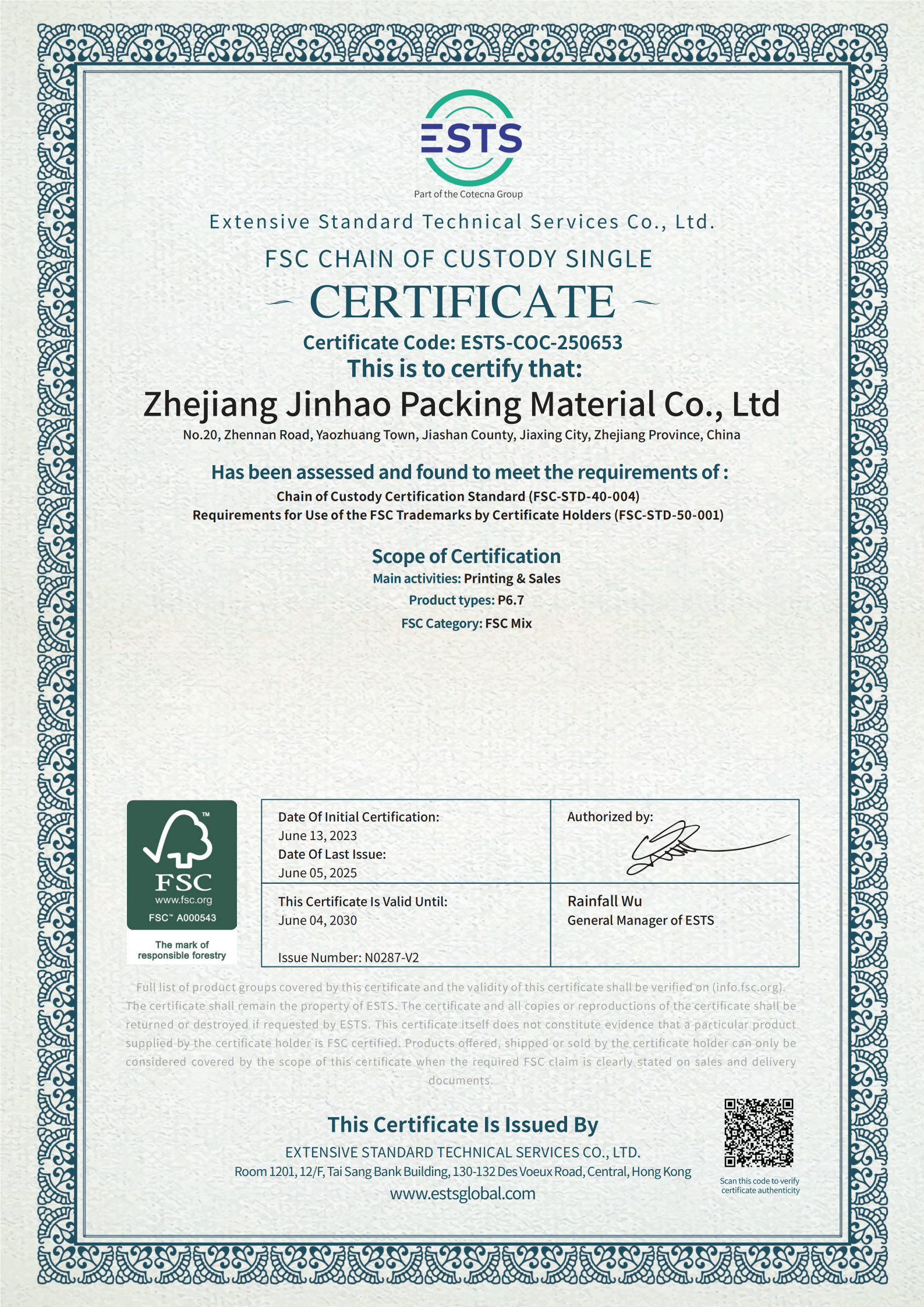
| FSC Chain of Custody Single Certificate | ESTS-COC-250653 | ESTS | Printing and sales of FSC Mix paper products | Issued 2025-06-05, valid to 2030-06-04 |
Because certificate windows roll over, confirm the renewal status of each document at order time. The BRCGS record in particular carries a recorded expiry of 2026-06-01 on the certificate on file and should be re-checked before it is placed in a tender pack. KingHonor also references amfori BSCI social audit documentation among its compliance records.
FAQ
Which certificates should a fast food brand verify before ordering PE-coated paper containers?
Verify four documents. ISO 9001:2015 (certificate 00623Q31644R4S, issued by QAC, recorded expiry 2026-12-03) covers lamination, printing, slitting of laminated paperboard and paper cup processing. ISO 14001:2015 (00623E31318R4S, QAC, recorded expiry 2026-12-03) covers the same operational scope under an environmental management system. BRCGS Global Standard Packaging Materials (C0691603-BRC4, issued by NSF Certification, LLC, recorded expiry 2026-06-01) is the most directly relevant, because its scope covers PE or PLA coating, flexographic printing, die-cutting and forming of boxes, trays and bowls for food service. FSC Chain of Custody (ESTS-COC-250653, ESTS, valid to 2030-06-04) covers printing and sales of FSC Mix paper products. Confirm the current renewal status of each at order time, since certificate dates roll over.
Can a PE-coated kraft container hold hot, oily food without the paper wicking?
Yes, provided the coating is continuous across the base seam, side-wall overlap, rim and any fold line. KingHonor states that its products can be produced with PE coating or PLA coating for oil-proof, waterproof and heat insulation performance (company-reported). The coating works as a barrier by preventing oil and water from wetting the cellulose fibre, so the paperboard keeps its stiffness through the delivery window. Barrier integrity is a construction question rather than a paper-weight question, so ask for the coating specification and the test method behind the claim, and validate with your own menu item at service temperature.
What drives the cost of a PE-coated container compared with a plain paper one?
Four cost drivers matter: base material (brown kraft versus coated white cardboard), coating resin and the coverage applied, print (flexographic printing sits inside the certified scope), and die-cutting and forming complexity for the chosen geometry. Total order cost therefore moves with monthly volume and with how many SKUs share one print run. In KingHonor’s fast food chain case, 10 million disposable food containers were supplied per month and the client achieved a 15% reduction in packaging costs using eco-friendly materials. Compare quoted total cost at a realistic annual volume rather than unit price at sample quantity.
How should a brand test a sample before committing to a production run?
Run three tests with your own food, not with water. A hot-fill hold test at service temperature for your longest delivery window; a transit test with containers stacked as they would be in a delivery bag; and a tip test with the container on its side for several minutes. After each stage, inspect the base seam, side-wall overlap, rim and corners for darkening, softening or separation. KingHonor’s customization scope covers size, design, logo printing and eco-friendly material selection, so the sample stage is also where print and dimensions should be signed off against the menu portion.
What production capacity and lead time should a buyer plan for?
KingHonor operates a 50,000 m² facility with 200+ employees and 20 core technical staff, producing an annual output of 20,000 tons of food-grade PE coated paper and over 2 billion paper cups and paper food containers, with a 60% export ratio across the United States, China, Europe, Australia and the Middle East. Documented client programmes run at 10 million units per month for fast food, milk tea and airline accounts. SKU-level lead time is confirmed at quotation, so plan the ramp against monthly volume and hold a buffer for print changeovers. To start, request a sample set or a quotation against your monthly volume and SKU mix.
Next step: test the barrier on your own menu
KingHonor Paper Products Co., Ltd. manufactures PE-coated Kraft Paper Square Box XQ, Kraft Paper Bowl ZT and White Kraft Food Tray ZT for fast food, beverage, airline and catering customers. Send your menu list, monthly volumes and target delivery window, and request a sample set or quotation for the specific models you need.
Product catalogue download: KingHonor disposable food paper container brochure
Website: www.kinghonorpack.com
Contact: Mr. Yang · Email: info@kinghonorpack.com · Tel: +86 13918832889 · WhatsApp: +8618205730716
Address: BINH TIEN 2 HAMLET, DUC HOA HA COMMUNE, DUC HOA DISTRICT, LONG AN PROVINCE, VIET NAM
Conclusion
Grease leaks in takeaway packaging are predictable. They appear at the base seam, the side-wall overlap, the rim and the fold lines, and they follow from interrupted coating coverage rather than from insufficient paper weight. A PE-coated container addresses the mechanism directly: the polymer film keeps oil and water out of the fibre, the fibre stays stiff, and the container survives the delivery window in the shape it left the kitchen in.
For a fast food brand moving from evaluation to execution, the practical sequence is short. Classify menu items by leak risk, choose geometry before decoration, write the coating type into the specification, validate with your own food across three tests, and attach current certificates to the file. Applied consistently, that sequence converts a complaint category into a controlled specification — and it is the same sequence that makes a supplier comparison meaningful in the first place.
Have Questions or Need More Details?
Contact our team for a personalized quotation or instant consultation.
Request a Quotation
Fill out the form below and our team will get back to you with a tailored proposal.
WhatsApp Direct Chat
Prefer to chat in real-time? Message us on WhatsApp for instant assistance & quick answers.
- Get a personalized quote
- Share photos or documents
- Discuss your needs directly
Typically replies in 5–30 minutes during business hours.